
Turin, Italy
“Finally, FINALLY, someone has brought up the impacts of agriculture on the Oceans.” His clear blue eyes held me in the steady gaze that only a true mariner can possess. The Pacific fisherman, Jeremy Brown, proceeded to tell tales of the sea to the Slow Food US delegates gathered around the circular breakfast table on my last morning in Turin; except these were not tales of yore, but apocalyptic reflections of the state of today’s Oceans. He spoke of sailing through the great Pacific gyre where enormous swaths of plastic confetti is scattered across areas larger than continental US. “If it were an island, it would be easy to clean up, but this is impossible.”
The Oceans are our sinks into which agricultural chemicals are drained. Even though we stopped using DDT and PCBs a generation ago, they still persist in the Oceans. These persistent organic pollutants (POPs) are pervasive; we have no way to remove them once they are introduced to the environment. We are just starting to understand how extensive the impacts are through people like Chelsea Rochman, who is a marine biologist looking at plastics in the marine food web. Plastic is a material which for some reason is able to absorb high concentrations of POPs. She is now confirming that POPs absorbed by ocean plastic desorbs into the flesh of the fish who mistakenly eat the bits of plastic thinking it is food. The fat loving POPs work their way up the food chain, becoming more concentrated each time they are consumed.
The Ocean seems like a distant place to people who dwell in the mountainous desert. In fact, there is an organization based in Paonia, Colorado, who is compiling scientific studies on endocrine disruption based on studies initially done with aquatic species. Theo Colborn is a scientist who recognized the trans-generational effects of endocrine disruptors in the Great Lakes marine food web. She found that when we are exposed to hormone disrupting chemicals, it is our children and grandchildren who suffer the consequences. She founded the Endocrine Disruption Exchange as a platform for scientists to post their work so that we can see the commonalities between humans and affected wildlife because, surprisingly, endocrine systems in all living beings are nearly identical. The impacts on humans include infertility, obesity, degenerative illnesses like diabetes, ADHD, autism and cancer. In her book, Our Stolen Future, Dr Colborn describes how easily POPs can take flight and traverse immense distances on an air current, or hitch a ride in the fat of a migrating animal. In other words, chemicals used in industrial agriculture anywhere in the world releases POPs in such a way that these endocrine disruptors arrive onto our doorsteps. We are all in this together.
I came to the Terra Madre conference in Turin with plastic on my mind because at that time I was attending a residency at La Napoule Art Foundation in France where I was asked to create artwork specifically in regards to plastic’s impact on the environment and our health. Tracing the processing of our convenience food back through the production and growing methods inspired me to take a closer look at the glut of packaging in our culture and what kind of effects it is having not only on our health but also on our notions of “disposability”. For years, my work has explored the collisions between traditions and globalization, and my current work explores these intersections on a platform of food; probing into both industrial and sustainable models of food production and consumption.
The Slow Food movement has made a big impression on me. Like many new mothers, I started to question how we are nourishing our children. As I come to understand the global structure of our industrial food system, I’ve become terrified about our health in this chemical age. But here is an organization which is not only tackling our most pressing problems; we are doing it in a way which celebrates the joy of community that is built around traditions of nourishment. If I have taken one thing away from attending the Terra Madre conference as a Slow Food delegate, it is the recognition of how important it is to empower people who are working the land in sustainable ways. The organization offers a tremendous respect for farmers. People who grow our food are on the frontlines of the battle with climate change and can offer important solutions through their deep understanding of land and weather patterns. Their approach to agriculture respects biodiversity and works in harmony with the land. Today’s small farmers are incorporating new sustainable technologies while maintaining traditional methods that shift according to their particular landscape.
The Slow Food movement offers solutions that couldn’t be more accessible: know where your food comes from, and prepare it with love. People who complain about the expense of real food should check out Slow Food USA’s campaign to share real food recipes for under $5. People who balk at the time it takes to prepare food can instead see it as an opportunity to come together as a family to bond around the preparation and enjoyment of nourishment. It places a lot of emphasis on the localizing our consumption of food by growing it in our own back yards and through getting to know our farmers.
Here in the desert southwest, we have a number of people who are working to preserve our food heritage. We have our own Southwest Presidium, The Navajo Churro Sheep, which was represented at Terra Madre by Carrie House (carrie@balancingfactors.com to order direct from the farm). Presidia, as described on the Slow Food website, are “local projects that work to improve the infrastructure of artisan food production. The goals of the Presidia are to guarantee a viable future for traditional foods by stabilizing production techniques, establishing stringent production standards, and promoting local consumption.” It helps farmers maintain biodiversity which is essential to food security.
While at Terra Madre, I made a point to attend discussions which explored the collisions between traditional practice and globalization. I was struck by the similarity of stories that were told by people living in Columbia, Uganda and Papua New Guinea. Native people who have farmed their land for generations are being forcibly removed by multinational corporations who are essentially taking the land away from them with little to no compensation. The governments are often working with the corporations, and are the ones who profit from land grabbing. Some of the land grabbed lays fallow in a state of speculation. The rest of it is used for huge swaths of monoculture which grows mostly biofuel or feed for industrial meat production to serve the insatiable appetites of those in the northern hemisphere. The farmers are not able to grow food for their communities anymore. The money from trading in local markets is now flowing out of the country, decimating the social and economic fabric of local communities. Instability easily leads to conflict. The global ramifications of how we choose to consume food are vast. Choosing to eat from the industrialized food system supports this atrocious type of neo-colonialism. It can be surprising how localizing our food choices can have an impact in Africa, but that impact is direct. Aside from the obvious humanitarian violations of an industrial agricultural model, the huge swaths of monoculture release endocrine disrupting chemicals into our environment which easily arrive right back on our own doorsteps, as described above.
There are several immediate ways we can impact on the social and environmental impacts of the Industrial Food Machine. Beyond eating locally, we can take a close look at our investment portfolios to make sure we are not supporting companies who define “international investment” as grabbing land away from local populations in unfair ways. We can truly “invest” in international communities by supporting programs like Slow Food’s Thousand Gardens in Africa project. Any number of microlending programs are also available if you would like a monetary return on your investment.
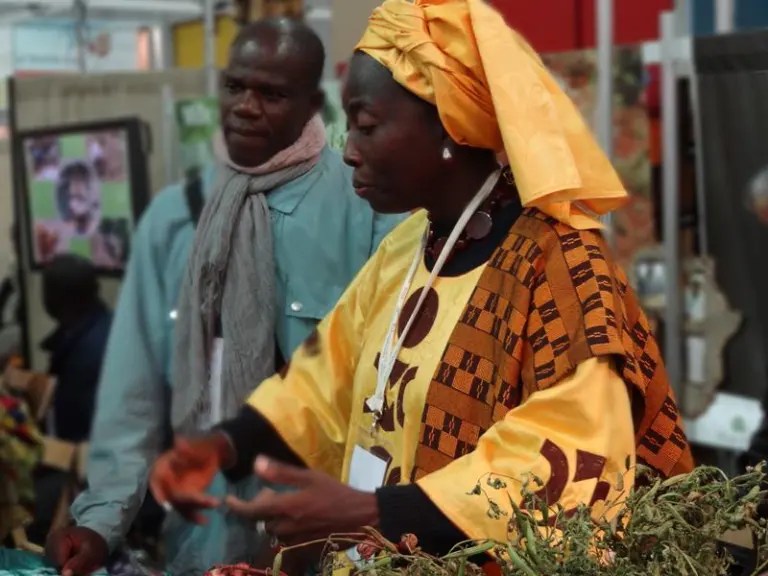
With participation from over 100 countries around the world, the Terra Madre conference was astounding in its diversity. Countries that are at war with each other had representatives there sharing nourishment. It was inspiring to see traditional dress worn proudly and customs shared warmly and to discover commonalities in the value placed on nourishment. Sitting with a Senegalese woman in an elaborate yellow dress, I asked if she grew food. She broadened her gleaming smile and answered in her deep, melodic voice, “No, I make feasts”. I responded that I knew of no better way to demonstrate love, to which she said, “Yes, this is why we are all here.”
 VOICES