
3rd Ghetto Biennial: De-centering the Market & Other Tales of Progress 2013
The first time I met Claude was in his garden, where he handed me a skull and through an interpreter asked if I’d ever held one before. I still had on my wool socks from a Denver winter, having been whisked off to the Grand Rue upon arrival at the Hotel Olafsson, so felt a bit discombobulated and wasn’t able to recall if I had actually held a human skull in my hands before this point. I decided the one at the top of my spine sufficed, so looked him in the eye and answered, ‘oui’. We became fast friends.
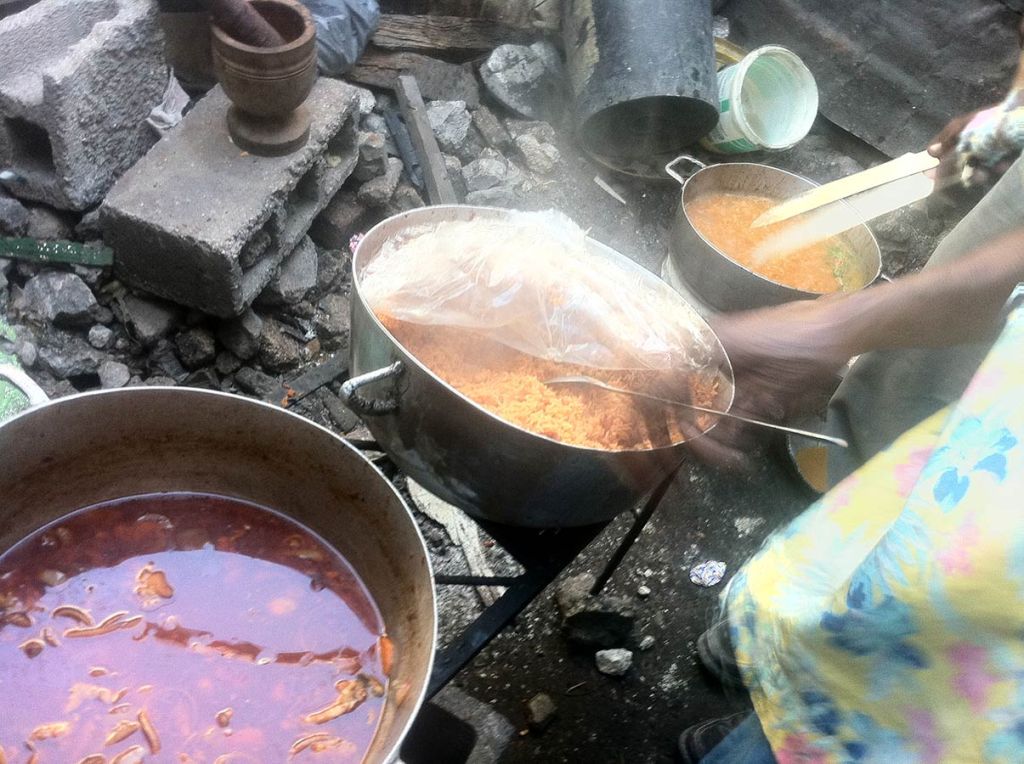
This was my first visit to Haiti and it became a meditation on the rhythms of different lakou communities that made up the Grand Rue neighborhood through which the Ghetto Biennial takes place. When we move through high energy spaces, interactions become tangled and it can be hard to discern purpose in the way people occupy and move through the twisted and dynamic footpaths that make up this urban quarter. When we sit still and observe over the course of hours, we start recognizing complex functioning within the folds of confusion. Indeed, the confusion itself is seemingly designed as a protective measure against overly aggressive forces. In order to learn about this place, I was sitting with grandmothers in various corners as they spent hours preparing traditional Creole cuisine to share between foreign artists and neighbors. I was particularly drawn to the community around Lakou Claude, which wound its way up through families of skilled wood craftsmen to Basile’s yard at the top of the hill.
Claude hosted the largest meal in his lakou. Word had gotten out that we were freely sharing the food we were preparing, so the crowd had grown substantially. To my untrained ear, the distribution of the meal elicited seeming chaos, but it was actually a vociferous negotiation on who got to partake in sharing this meal. I distinctly remember exchanging a long, slightly surprised gaze with Claude as we both stepped back from the simmering pots, choosing the role of quiet observers as he handed the negotiations over to more capable voices. As an interesting comparison, the arts council had learned about our shared meals and tried to replicate the action by sending a truck to give out food. A full-on riot ensued because there was no voice guiding the distribution to those who dwelled within the folds of the lakou community.
Years later, a local television news crew interviewed us about our work with trees in Claude’s Garden wherein they assumed I was there ‘building community’. I laughed, remembering the negotiations that surrounded all our shared meals and answered, ‘no’. People here cannot survive without strong, interwoven support. If anything, it was the foreign artists who were learning about ‘community’ from the Grand Rue Atis. Claude was a central pillar of this neighborhood, around whom community thrived.
 VOICES