
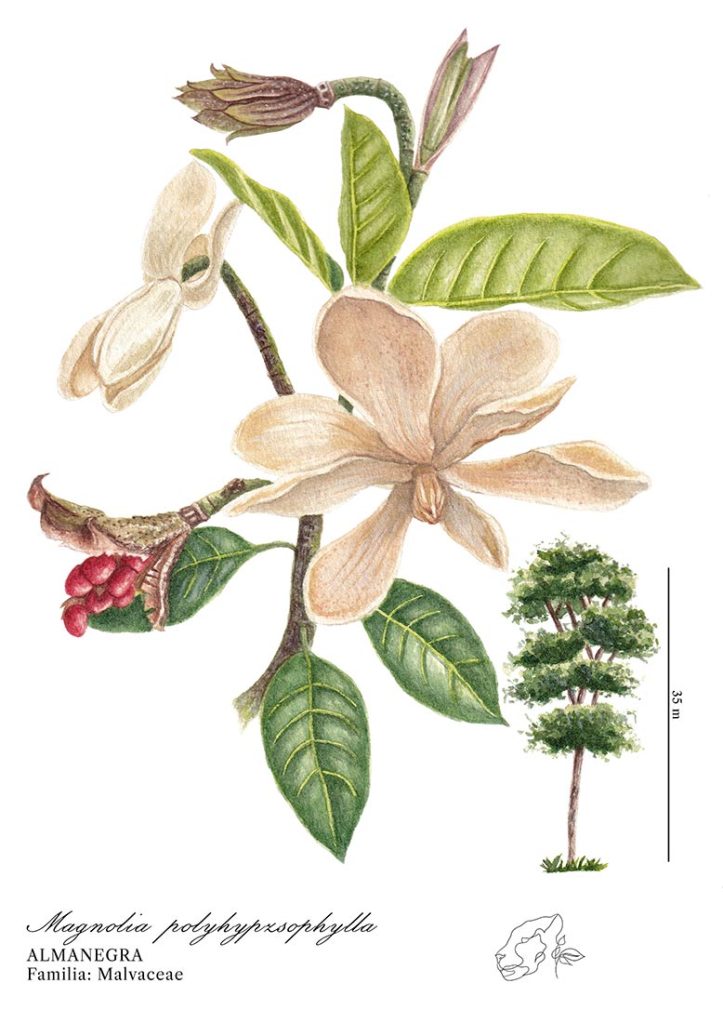
A timber tree endemic to Antioquia, Colombia, currently classified as Critically Endangered. Its populations have drastically declined due to deforestation and habitat loss. This species represents the urgent need to protect endemic Andean forests and highlights how scientific illustration can help make threatened plants visible and emotionally meaningful to the public.
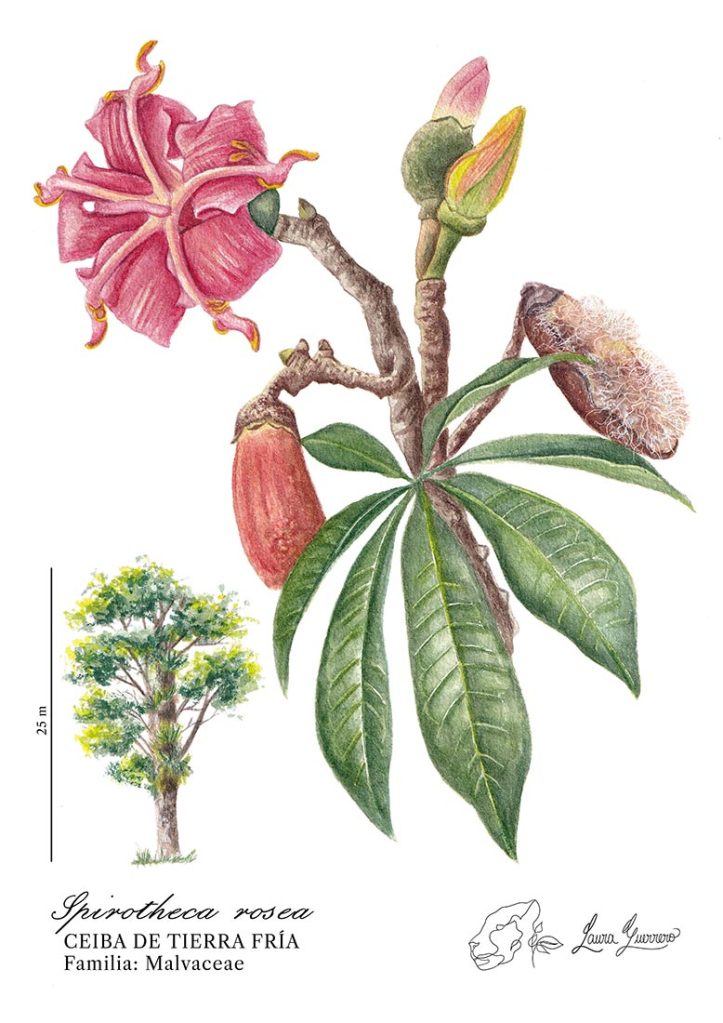
A native tree species associated with andean ecosystems. Trees of this genus play an important ecological role as habitat providers and contributors to forest structure. In many Latin American contexts, ceibas are also culturally significant, symbolizing connection, protection, and life. Illustrating this species is a way to weave together ecological importance and cultural memory.
My work explores scientific botanical illustration as a tool for conservation, memory, and decolonization. I create watercolor illustrations of native Colombian plant species using an aesthetic inspired by 18th-century botanical illustration, particularly from the era of the Royal Botanical Expedition during the Spanish Viceroyalty.
While these expeditions produced invaluable records of biodiversity for future generations, they were also part of a colonial system that documented natural resources as inventories for the Spanish Crown. The knowledge and labor of local naturalists, often referred to as “criollos” (a historical term for people born in the colonies of European descent, which today is critically reinterpreted in discussions of identity, power, and knowledge production) were largely erased or uncredited.
Through my work, I seek to resignify scientific illustration as a contemporary, situated practice that honors local knowledge and gives visibility and value to national naturalists and artists who engage with their own territories today. This is an act of creative conservation: reclaiming visual languages of science to tell stories from the Global South, rooted in lived relationships with our ecosystems.
Where do you see conservation efforts focused in your community?
Colombia is one of the most biodiverse countries in the world, yet much of its population is disconnected from and unaware of its own biodiversity, especially plant diversity. Conservation efforts in my community are often led by environmental organizations, grassroots collectives, and educators working in reforestation, ecosystem restoration, and environmental education. However, there is still a strong gap between scientific knowledge and everyday life. I see a growing need to focus conservation efforts on cultural connection and public awareness, helping people recognize native species as part of their daily landscapes and identities, not as distant or abstract concepts.
What is your current “relationship” with wildlife conservation?
My relationship with conservation is both professional and personal. As an ecologist and scientific illustrator, I engage with conservation through research, visual communication, and education. Illustration allows me to slow down, observe deeply, and build intimate relationships with wildlife species, understanding their forms, habitats, and vulnerabilities. Conservation for me is not only about protection policies, but about building emotional bonds with non-human life. Drawing and painting becomes a contemplative practice of attention and care.
Where do you see art and science working together for wildlife conservation?
Art and science work together most powerfully in the space of translation. Scientific knowledge often remains inaccessible to broad audiences, while art can create emotional, aesthetic, and symbolic bridges. Scientific illustration sits precisely at this intersection: it is informed by rigorous observation while inviting curiosity, wonder, and empathy. By using historical visual languages (18th-century botanical illustration) in a contemporary and critical way, I aim to open conversations about how knowledge is produced, who gets to represent nature, and how we can reimagine conservation from decolonial and local perspectives.
How do you encourage your community to live “in a conservation mindset”?
I encourage a conservation mindset through visual storytelling, workshops, and participatory practices using illustration as an environmental education tool. By teaching people how to observe, draw, and name native species, I invite them to recognize plants and animals as neighbors rather than distant “wildlife.” Art becomes an entry point to care: when people learn the name of a tree, understand its story, and see its vulnerability, they are more likely to protect it. My goal is to foster everyday practices of attention. Looking closely at urban and rural plants, valuing native species, and understanding conservation as a daily, relational act rather than only a large-scale policy issue.
I am an ecologist with studies in scientific illustration and science communication. My practice weaves art, observation, and environmental education to make biodiversity visible and emotionally meaningful. I believe conservation must be rooted in community relationships with place, and that art is a bridge between scientific knowledge and lived experience.
eco-conspiracies exhibition at the GALLERIES on DOWNING
420 North Downing Street, Denver Colorado 80218
DATES: March 1 – April 30, 2026
An immersive installation sharing stories of creative restoration work by practitioners within the Creature Conserve community interspersed with local artists’ multi-disciplinary approaches of re-inhabiting conservation.
CON: with
SPIRE: to Breathe
The idea of eco–conspiracies grows from the idea that we breathe together with plants. As the foundation of ecological webs, native and bioregional appropriate plants serve to restore habitats, especially through the tight urban spaces where most of us dwell. Opening space for contemplative practice, we invite visitors to slow down and breathe with surrounding plants in our spheres, practice creative acts of sci/art conservation, and share seeds and their stories with neighbors to pass regenerative acts forward.
Using Art to Bring Wildlife Conservation Closer to Home
Broadening perceptions of ‘home’ to include outdoors spheres around our lived-in structures, we encourage deepened relationships with non-human species who dwell with us in the urban corridors we call home, thinking of ways we may increase connectivity across Denver’s communities.