
SEED Haiti grew out of participation in four iterations of the Ghetto Biennial. Every two years, international artists arrived for a month to collaborate with members of the Atis Rezistans along the Grand Rue in Port-Au-Prince, Haiti. Our work began by sitting with grandmothers as they prepared community meals. This allowed us to slow down and tune into the rhythms of the neighborhood and how community functions. We started saving seeds from the different ingredients used during meal preparations, and tried a myriad of approaches to cultivating the densely populated neighborhoods. Ultimately we learned that we could indeed grow a food forest in this area which is largely dismissed as hopeless. In fact, plant relationships are still considered sacred and there is immense interest in augmenting existing efforts at preserving plant traditions and re-wilding urban areas.
current work
Food Forests
After nearly a decade of experimenting with what will grow in the dense neighborhoods along the Grand Rue in central Port-Au-Prince, we see that trees like Moringa, Chocogout (Maya nut) and an assortment of fruit take up small footprints, supplement nourishment and provide shade. Vines grow well across the corrugated rooftops, offering green insulation against the heat while producing large ‘joumou’ the local heirloom pumpkin. Micro-gardens of endemic medicinal plants are tended in corners as the base level of this urban ecosystem. The first Africans who escaped slavery fled into the steep mountains and were received by indigenous Taino, who taught them their sacred plant relationships. To this day, these plants are tended in the most unexpected urban corners in one of the most extraordinary acts of preservation. We are currently seeking funding to grow this Haitian led effort of cultivating food forests through the Red-zones of central Port-au-Prince and steep slopes of Petionville.
2024: RIP Jean-Claude Saintilus
Claude was an important colleague in this work. In Memoriam:
Part 1: Shared Meals – 2013 Biennial
Part 2: Food Forests – 2015 Biennial
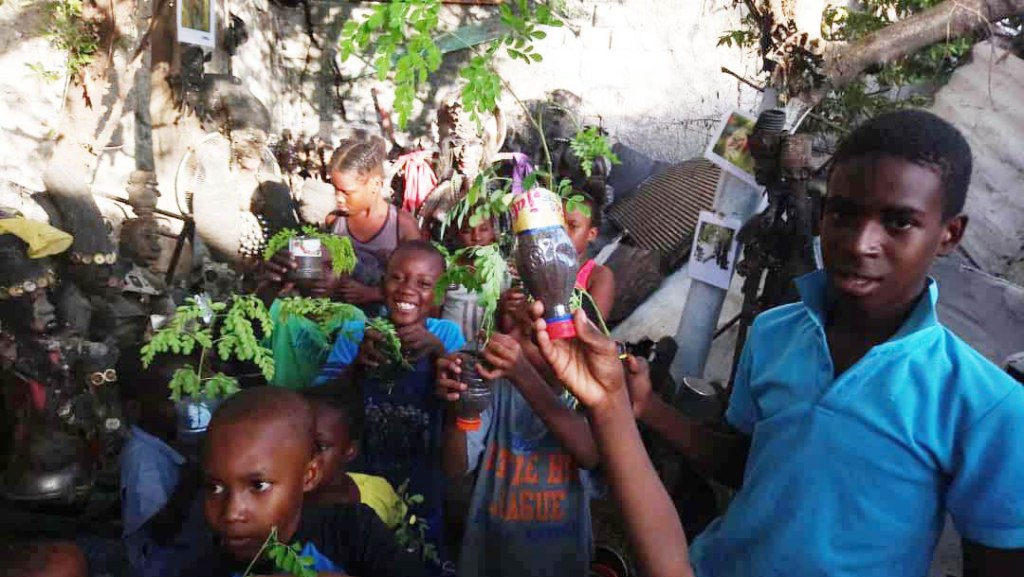
By 2023, the Moringa trees were an established part of the neighborhood, providing shade and nutrient dense greens to supplement diets defined by scarcity.
How we got here: ghetto biennial
Restoration Liberation: Mountains Beyond Mountains
2019 Ghetto Biennial
SEED :: disperse
2017 Ghetto Biennial
Two years after installing pocket gardens in the previous biennial, we examined the gardens of the Grand Rue to assess which plants thrived. We used what we learned in growing plants in a heavily populated area of the city to apply what worked to the areas that did not fare as well. We found that trees fared the best, and that joumou (the local pumpkin) can easily trail along rooftops. At our workshops, we share a meal with joumou, then plant seeds with the youth who in turn tend the seedlings and in time have a product to sell or trade which supports food security.
Lakou Jean-Claude Santillus | Initiating the 5th Ghetto Biennial, A Cartography of Port-au-Prince
A Visit to SAKALA | An urban nursery in Cite Soleil provides young trees for gardens along the Grand Rue
Lakou Basile | Collaborations with SOIL & woodworkers along the Grand Rue

Sacred Soil: Gardens of the Grand Rue
2015 Ghetto Biennial | 1st place, People’s Choice award for Foreign Projects
Initiated during the 4th Ghetto Biennial, members of the Atis Rezistans artist collective worked with Lee Lee to establish a seed library, plant the foundation for the canopy of an edible urban food forest and build pocket sized permaculture gardens scaled to fit the small, tangled footpaths that meander through the Redzone along the Grand Rue in downtown Port-Au-Prince. The project won first place for foreign artists in the People’s Choice Awards, and the gardens continue to thrive.
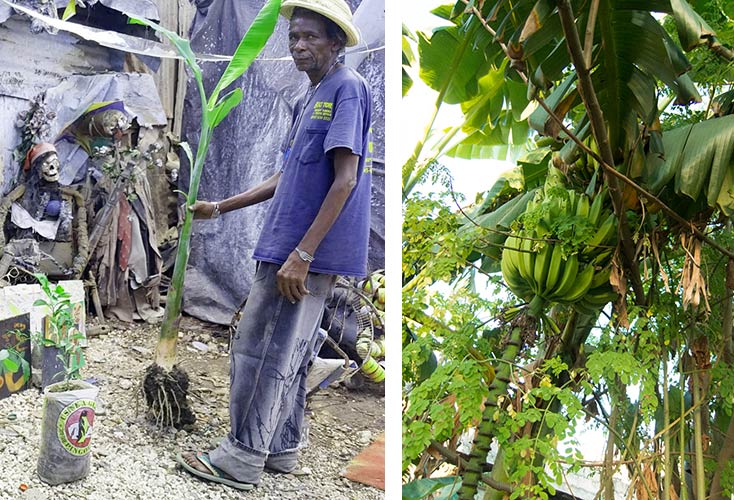
Left: photo by Rossi Jacques Casimir
Right: photo by Richard Arthur Flemming
2014 Narrative | Tchaka: Exploring collisions between Haitian food sovereignty & US food policy | Presented to the Society of Caribbean Studies, University of Glasgow
Nourish: Grandmother Recipes
2013 Ghetto Biennial
During the 3rd Ghetto Biennial, Lee Lee gathered recipes from the Grandmothers of the Grand Rue as they prepared a series of pop up dinners shared by the visiting artists and local Atis Rezistans community. As an initiation for the Gardens of the Grand Rue project in 2015, we prepared Tchaka to honor the patron of agriculture, Azaka. This particular recipe was also used as a framework for a narrative to explore the complexities of the relationships between Haiti and US food policy.
Living in the Shadow of Giants: Food Justice Collisions between Haiti and the US
Presented for the Society of Caribbean Studies
University of Glasgow, Scotland
Tchaka
Poulet Legumes
Diri Djon Djon
Poisson Gwo-Sel
Mais Moulin
plant mobilities: (neo)colonialisms
REVOLUTION | Bastille Day at the SEED barn
Sea Shanties & SEED Stories: Initiation of the Pendleton House Gardens at the first annual Blue Hill Maritime Heritage Festival, Maine
 VOICES